Publishing Pilgrimage
Why I published the first U.S. edition of Pilgrimage in 50 years.

About a year ago, I became a publisher. It was an act of desperation.
Back in March 2016, as part of my second year of reading exclusively the work of neglected women writers, I took up the first volume of the 1938 Alfred A. Knopf edition of Dorothy Richardson’s Pilgrimage, embarking on what I expected would be a challenging read — not expecting that it would prove a transformative one. As I wrote then, it was:
Appropriate to devote a month to Richardson during this (second) year of exclusively reading the works of women. For Richardson was never anything but ferociously her own person, and that person was most definitely female. As Derek Stanford wrote in an obituary piece in 1957, “In all the two thousand pages of Pilgrimage there is not one effort to see the world from a man’s point of view.”
I was surprised to find that Pilgrimage even qualified as a neglected book (or 13 of them). I’d studied 20th century English literature enough to recognize it as an early milestone in the development of the modernist novel, to have seen numerous copies of the Virago Modern Classics set with its Gwen John covers in bookstores. But I assumed that it was in print and easily available and therefore not a legitimately neglected book.
Instead, I discovered that the Virago edition had never been officially distributed in the U.S., and even when I started looking for copies when I visited London bookshops, there were virtually none to be found. Copies of the complete 1967 Dent edition were scarce and ran $200 and more, so I opted for the 1938 Knopf set, which I got for just $75 from John Schulman’s Caliban Books in Pittsburgh. (A few years later, John and his accomplice were convicted of stealing rare books from the Carnegie Library. I am certain that my set was not among them.) When it came time to read the last chapter-volume, March Moonlight, which was only published in 1967, I couldn’t find a Virago set and had to opt for the fourth volume of the garish 1976 Popular Library edition.
My first time through Pilgrimage took a considerable effort. Although I’d read my share of modernist fiction and was accustomed to both the use of stream of consciousness narration and the abandonment of the signposts (“Later that day,” “When she returned to London,” “She remembered her visit to Kent when…,” etc.), Richardson’s deliberate rejection of many of the structural elements of traditional fiction makes far more demands on the reader than even, say, Virginia Woolf. Compared to Richardson, reading many modernist novelists seems like cruising along a well-maintained, well-striped and signed freeway (autoroute, motorway), while at countless points in Pilgrimage, we turn the corner on a Bloomsbury street and find ourselves in Hypo and Alma Wilson’s home in Kent weeks or months later — or weeks or months earlier.
But immersion in Pilgrimage soon changes how one approaches a text. As much as annotation or access to George Thomson’s Notes on Pilgrimage can help in explaining Richardson’s many otherwise obscure or cryptic references, it never provides such reliable guardrails that there won’t be times when you read along for a paragraph or page or two just hoping to find some clue, some landmark by which to orient, to understand where you are — or rather, where Miriam Henderson, Richardson’s protagonist, is.
But disorientation becomes as much pleasure as challenge as one progresses. As much as we’ve all heard that we should let a book’s language flow over us, many if not most novels are peppered with signposts that keep us focused on the itinerary (AKA the plot) and never let us wander too far from a point of reference. In Pilgrimage, on the other hand, particularly in passages where we are working alongside Miriam as she tries to make sense of an interchange with Dr. von Heber or Eleanor Dear or to figure out how whether Mr. Hancock is a potential suitor or just a well-meaning employer, we often find no clear connecting thread to tie one sentence to the next, one paragraph to the previous. Instead, as we sometimes do with poetry, we give up trying to solve the puzzle and simply open ourselves to the mood of the words.
Richardson never liked having her approach described as stream of consciousness, and on my fourth journey through Pilgrimage, I’ve become convinced that it’s the wrong term. In Chapter VIII of Interim, chapter-volume 5, Miriam muses on the nature of thought while glancing through a book (which she likely invented):
Her eyes scanned unwillingly. Fabric. How did he find his words. No one had ever said fabric about anything. It made the page alive … a woven carpet, on one side a beautiful glowing pattern, on the other dull stringy harshness … there is a dangerous looseness … her heart began beating apprehensively. The room was dead about her. She sat down tense, and read the sentence through. There is a dangerous looseness in the fabric of our minds. She imagined the words spoken, looseness was ugly, making the mouth ugly in speech. There is a looseness in the fabric of our minds.
That phrase — fabric of our minds — seems a far more appropriate metaphor for Richardson’s style. Elsewhere in Interim, Miriam recalls having read Oliver Wendell Holmes, Senior’s “Breakfast Table” books. In The Autocrat of the Breakfast Table, Holmes writes:
Put an idea into your intelligence, and leave it there an hour, a day, a year, without ever having occasion to refer to it. When, at last, you return to it, you do not find it as it was when acquired. It has domiciliated itself, so to speak, become at home, entered into relations with your other thoughts, and integrated itself with the whole fabric of the mind.
This quote, though perhaps not what Richardson had in mind, comes closer to what Richardson presents when she lets us into Miriam’s thoughts. Even in something as simple as Miriam waiting for an underground train, we have sensations and thoughts from the present, thoughts envisioning the future, and a recollection from the past (“Miss Scott was Scotch”):
The sense of a complex London life crowded with engagements made her pace in spite of her weariness up and down the platform at Gower Street. Its familiar sulphurous gloom, the platform lights shining murkily from the midst of slowly rolling clouds of grey smoke, the dark forms and phantom white faces of waiting passengers emerging suddenly as she threaded the darkness, revived her. By the time the train rolled slowly in behind its beloved black dumpy high-shouldered engine with its large unshrieking mushroom bell-whistle the journey had changed from being an expedition to a spot within five minutes’ walk of Sarah’s, unconfessed to Sarah, and had become a journey on the Metropolitan; going indeed outside the radius into blackness, but going so far only because the Dante lecture, wandered out of London was waiting there; and to be repeated at the end of the evening safely returning through increasing gloom until the climax of Gower Street was reached again…. Miss Scott was Scotch.
As she wrote Pilgrimage, Dorothy Richardson was twenty years or more from the experiences that she transformed into Miriam’s. Some of what happens, what Miriam experiences and thinks, is directly autobiographical. Some is adapted. Some is invented. Some things are merged, many things are left out. Even knowing Richardson’s biography does not always improve one’s understanding — indeed, at times it can mislead.
As a consequence, Pilgrimage is complex and opaque and yet is full of moments of crystal clarity, which makes it a work that one can return to again and again and again — which is certainly the mark of a masterpiece. After reading Pilgrimage on my own the first time, I had the good fortune to discover that a then-fellow Brussels expat, Kate Macdonald, was also reading it. I loaned Kate my Popular Library volume for March Moonlight because she had the 1938 Dent edition, and we agreed to have a dialogue by email about our respective impressions.
That first reading just whetted my appetite to return to Pilgrimage, but I wanted to have company the second time around. And so when some folks on Twitter began discussing having a Pilgrimage reading group in late 2021, I created the ReadingPilgrimage.com website and organized monthly meetings on Zoom. Kate Macdonald joined me for our introductory discussion and thereafter we had outstanding support from Richardson scholars like Scott McCracken, Adam Guy, Rebecca Bowler, Kristin Bluemel, and the late Howard Finn, which made the whole experience richly illuminating and rewarding.
Though I led several online reading groups after that, nothing quite compared to the excitement and satisfaction of engaging with Richardson’s work with other readers, and I was eager to organize another group to pick up when our 2025 Dance to the Music of Time group finished. Unfortunately, the situation with Pilgrimage hadn’t changed. If anything, it had gotten worse. Virago was only offering the books via print on demand in the U.K. and none of the U.S. publishers I contacted showed the slightest interest in reissuing Pilgrimage here.
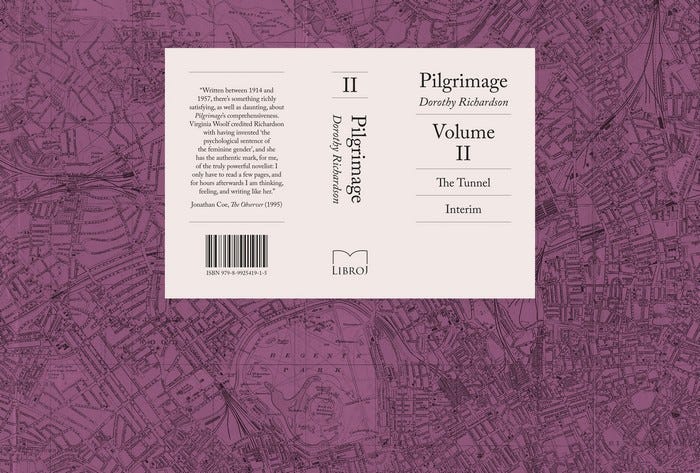
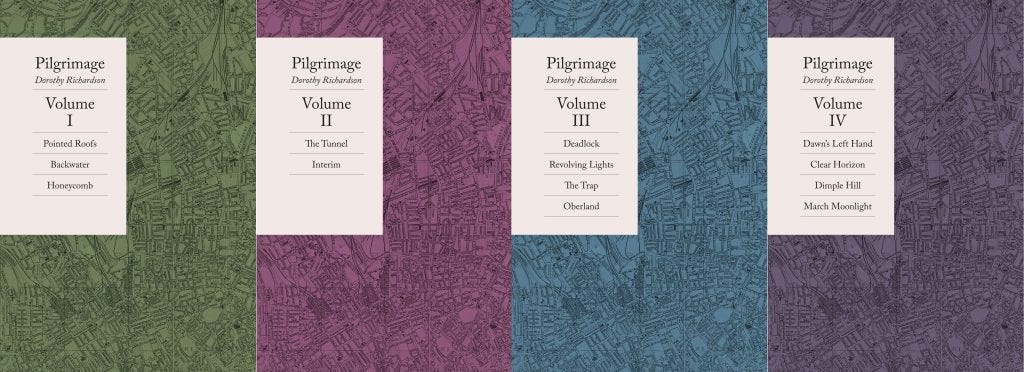
Finally, eager to launch a Piligrimage reading group that more readers in the U.S. could participate in, I decided to take the matter into my own hands. I contacted the Marsh Agency, which administers the Dorothy Richardson estate, and contracted for permissions to publish the chapter-volumes still under copyright. I then enlisted Louise Aspinall, the fabulous book designer I’ve been blessed to work with since the beginning of the Recovered Books series for Boiler House Press, to take on the design and typesetting and we began discussing the overall look. I wanted to stick with four volumes, but with Oberland in volume III, unlike the Virago and Dent editions, and I wanted them to stand out clearly as a set. We quickly settled on a common background of a London map from 1895, but with a different color for each volume. The maps are also slightly offset across the volumes so that when placed together, the map flows across the spines — though I suspect no one notices that. We also agreed to use a contemporary version of the same Caslon typeface as was used in the original Duckworth first editions.
The biggest decision, though, related to the text. Dorothy Richardson’s ideas about everything from chapters to punctuation changed over the course of writing Pilgrimage, and when Dent approached her with the idea of releasing what it considered a “complete” edition in 1937, Richardson went back through the previous chapter-volumes and standardized things like the use of single versus double quotation marks to indicate dialogue and eliminating her liberal approach to ellipses (sometimes using as many as eight dots instead of the usual three). Though she did not rewrite so much as re-edit Pilgrimage, the result loses the sense of experimentation one notices at the textual level when reading first editions of the chapter-volumes up to Clear Horizon.
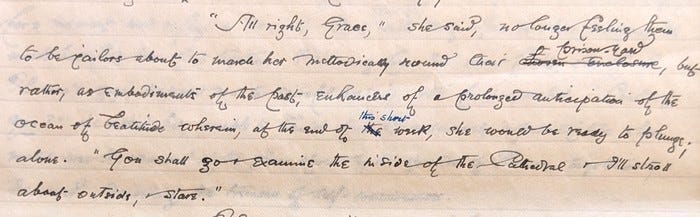
I felt this was a mistake. Pilgrimage is fundamentally an unfinished work, and the visibility we get into Dorothy Richardson’s changing ideas about things as basic as numbering sections within a chapter, using blank lines to separate passages, and putting eight dots in an ellipsis to indicate a break in thought when we read the first edition texts marks Pilgrimage as a work that never stopped being in progress. The Tunnel has thirty-three chapters. Interim, the next chapter-volume, has eleven. Richardson didn’t standardize her chapters in editing the 1938 edition, and thank God for that.
With each new chapter-volume, her vision changed. Unlike Anthony Powell, who said that he knew by the fourth volume of A Dance to the Music of Time that it was going to be a work of 12 volumes, Richardson just kept on writing until she grew too old and too tired to continue. Had she and her husband, Alan Odle, not lived such hard-scrabble and itinerant lives due to his health and her meager income, we might well have fourteen or fifteen chapter-volumes instead of thirteen — or, to be truthful, twelve and a fragment of the thirteenth.
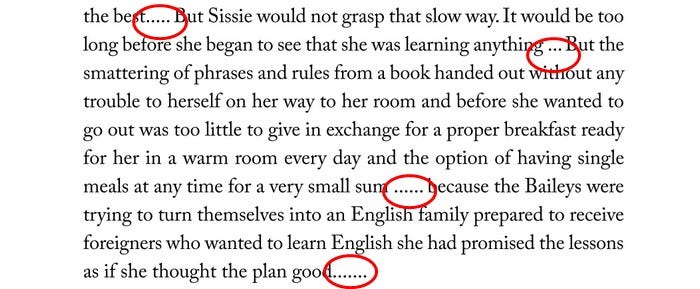
And so, I decided to stick with the first edition texts with all their glorious inconsistencies. Where Richardson originally numbered sections, the sections are numbered, and where she stopped doing that, they’re not. I tried to provide translations for all but the most obvious foreign phrases, to identify the many songs and poems that appear in snatches, and to explain essential references, but my annotation is far from being comprehensive or authoritative. Richardson fanatics will have to wait for further volumes of the Oxford edition of her works for that.
I named my press Libroj, which is Esperanto for books, primarily because I have a limited imagination and libroj.com was still available (no, there’s no website, but maybe someday if there are more books to come). With the support of Josh Rothes at Asterism Books, I was able to set up a distribution arrangement, and the first shipment of 100 sets arrived at Asterism in Seattle in July 2025.
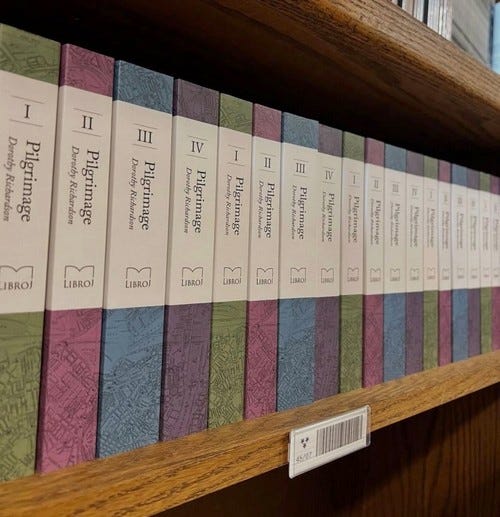
Since then, I’ve sold 144 sets of Pilgrimage, many of those to folks who had been waiting to take part in our 2026 Reading Pilgrimage group. My Instagram and BlueSky accounts have been my primary marketing channels, plus a bit of word of mouth. I bought small ads in several issues of the New York Review of Books. As far as impact on sales went, I wish I’d taken the money and burned it on my grill. It would have been more fun. The New York Public Library bought seven sets: Yay! I mailed out 100 postcards to independent bookstores around the country: bupkis.
My frustration is not about the money. I have the good fortune to be able to wait a year or two before I reach break-even. My frustration is the imperviousness of the American literary marketplace and academic institutions. Quite honestly, I wish I hadn’t had to do this. Dorothy Richardson’s work deserves to be in print and as widely sold and read as that or Virginia Woolf or James Joyce. This edition is as much a sign of the irresponsibility of American publishers and American scholars of 20th Century literature as a sign of respect for Richardson and the importance of her achievement.
Miriam Henderson deals with issues still deeply relevant today: earning a living; finding a place to live; getting along with roommates and employers; figuring out how sex fits in one’s life; shaping a way to “self-actualize” while holding down a job and keeping up with the demands of daily living; carving out an identity that isn’t defined (or constrained) by marriage or class or religion or gender. And Richardson’s vivid impressions and elliptical style mean Pilgrimage is a text one can return to over and over and find new meanings in.
I hope this new edition of Pilgrimage helps bring a new generation of readers to this revelatory work. Even if I never break even.
The Libroj edition of Pilgrimage is available from Asterism Books.
I love this—great insights into Richardson’s work and yours! It looks like I finally need to read Pilgrimage. About time!!! (Thank you!)
have been reading DR since finding her in the kentish town library in 1973. have never found her difficult. have appreciated that she doesn’t translate miriam’s french and german, which after all miriam herself understands perfectly.