Why Gale Wilhelm Stopped
She never explained her decision—but her work offers clues

Cross-posted from NeglectedBooks.com/?p=11176.
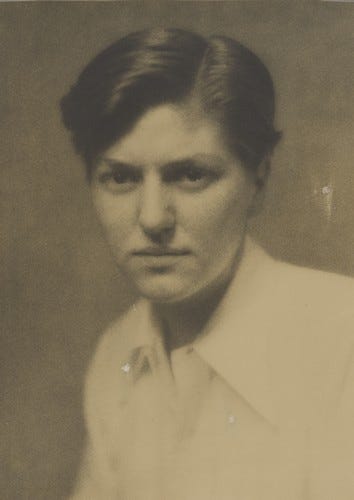
In August, we’ll be publishing a new edition of Gale Wilhelm’s 1935 novel, We Too Are Drifting, in the Recovered Books series from Boiler House Press. Despite the fact that We Too Are Drifting is a landmark in literature, the first mainstream American novel to depict lesbian relationships without moralistic or leering overtones, this will be its first publication since Barbara Grier’s Naiad Press reissued it in 1984.
In that edition, Grier wrote, “We know just enough about Gale Wilhelm to be tantalized.” Grier sketched Wilhelm’s biography from her birth in Oregon in 1908 through the start and apparent end of her literary career, until the trail faded in Oakdale, California in the early 1950s, supposedly with the death of her partner, Helen Page. Grier concluded by issuing the plea, “At this writing we are looking for her, or for proof of her death.”
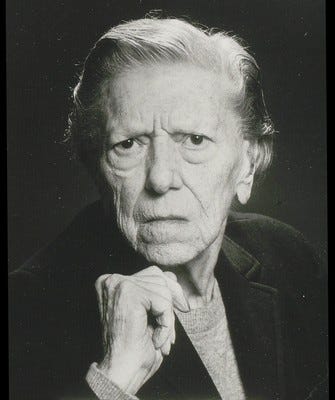
Wilhelm contacted Grier after the book came out, informing the publisher that she was living in Berkeley, California. Furthermore, Grier wrote in her introduction, Wilhelm said that “she did not consider herself lost for as she put it ‘I always knew where I was.’” On the other hand, in her own account of her life, included in the 1985 Naiad Press edition of Wilhelm’s third novel and second to deal with lesbian relationships, Torchlight to Valhalla, Wilhelm added virtually nothing new other than stating that she moved from Oakdale to Berkeley in 1948 and had lived “continuously in my present house for the past 32 years.” The 1950 census lists Wilhelm as living at the same address as Kathleen Huebner, with her relationship stated as “partner” and her profession as “writer.” Wilhelm and Huebner bought a lot at 1281 Campus Drive in Berkeley in 1953 and had a compact house designed and built for the now-astonishing price of $12,000. It was in this house that Wilhelm died of cancer in 1991.
These bare facts, however, provide no clue to the question that anyone who looks into Gale Wilhelm’s life and work asks: Why did she stop writing? Between 1935 and 1945, Wilhelm published six novels, as well as a number of short stories. Her papers at the Bancroft Library at the University of California Berkeley also include an assortment of poems, mostly unpublished, and a small amount of correspondence with publishers, editors, and agents — but almost nothing after her last novel, Never Let Me Go. Wilhelm’s papers were left to Kathleen Huebner, whose will passed them along to one of Wilhelm’s nieces, who in turn donated them to the Bancroft Library. There is nothing in the papers that suggests that any material from after 1945 was withheld or destroyed — but there is also nothing that suggests otherwise. Wilhelm’s literary trail does not fade away — it vanishes.
In the absence of factual evidence, one is left to look at Wilhelm’s books for clues. We Too Are Drifting and Torchlight to Valhalla (1938) are the natural places to start, given their themes. Set in San Francisco, Drifting is about a wood sculptor named Jan Morale and her relationships with Madeline, a married woman, and Victoria, a younger woman who ultimately leaves for the safety of a marriage condoned by her family. When Random House published the book in mid-1935, it gave Drifting widespread publicity and dozens of reviews appeared in newspapers around the country.
Harry Hansen, then one of the most popular syndicated book critics, praised Wilhelm’s “restraint with dealing with an abnormal theme,” mentioning Radclyffe Hall’s The Well of Loneliness in his next sentence in case readers couldn’t figure out that “abnormal” meant “lesbian.” Hansen felt that none of Wilhelm’s characters “seems to be flesh and blood” and compared her settings to the faint sketchiness of a Japanese print. He also dismissed “the sighing of one woman for another” as “of less import that a casual breeze,” but acknowledged that Wilhelm wrote with nuance and delicacy.
Torchlight to Valhalla also deals with a triangle, with Morgen, a young writer caring for her terminally ill father, pursued by Royal, a pianist, and drawn to Toni, a beautiful neighbor. It received similar reviews — mentions of The Well of Loneliness, enthusiasm for Wilhelm’s subtlety, and veiled dismay that the woman gets the woman and not the man. Although Bennett Cerf had cautioned Wilhelm in 1935 that “I definitely cannot consider publishing another novel on the homosexual theme at the present time,” Random House did publish Torchlight, as well as Wilhelm’s second novel, No Letters for the Dead (1936).
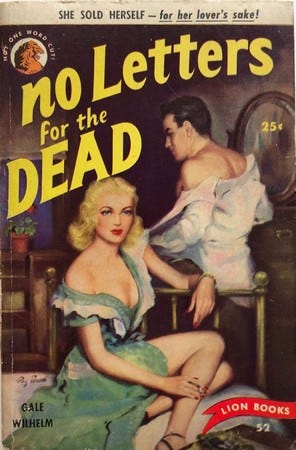
No Letters for the Dead was only slightly less problematic for Random House. Paula, newly arrived in San Francisco and expecting to join her lover Koni, learns that instead of divorcing his wife, he’s accused of murdering her. Over the next months, Koni is convicted and sent to San Quentin, while Paula is forced to resort to prostitution to keep from becoming homeless. She finds a sugar daddy of sorts, but any hopes of reuniting with Koni are crushed when he’s killed in a prison riot.
As with Drifting and Torchlight, No Letters was received with somewhat grudging respect. No reviewer could afford to show too much sympathy for the heroine or her situation, but Wilhelm’s hesitant hand was appreciated for not rubbing readers’ noses in what conventional tastes of the time would otherwise consider muck.
Wilhelm’s prose was often compared to Hemingway’s, but put samples of the two writers side by side and Hemingway can seem verbose by comparison. Here is an example taken almost randomly from We Too Are Drifting:
She said hello to Ann Carr and looked over her shoulder at Madeline and Madeline smiled and closed a big notebook and said, Just a moment, Jan. Jan nodded and turned her back to them and went to the window. There was fog in the sky clouding the sun and in the street there was movement and faint sound and it was all pleasant. She lit a cigarette and looked down into the street. A door closed and Madeline’s swift light steps came and Madeline slipped her hand through Jan’s arm and said, Darling, you look so marvelous I think I’m good for you. She held Jan’s arm against her left breast and for a moment held her cheek against Jan’s shoulder. Darling, I’m so terribly, terribly sorry I said all those things last night.
Of course, Jan said, looking down into the street. You told me.
No quotation marks. No adjectives or adverbs if she could avoid them. “Terribly, terribly” is Madeline’s manner of speech, not Wilhelm’s prose. As few commas as possible, too, so the title is We Too Are Drifting and not We, Too, Are Drifting.
Wilhelm’s parsimony with words and even punctuation can be off-putting at first, but once you become accustomed to her approach, Harry Hansen’s mention of a Japanese print makes sense. It’s as if she’s trying to write the absolute minimum necessary to paint the scene, the least information possible to sustain a plot, willing to perplex her reader at times if it saves a word or a sentence.
Wilhelm may dispense with words she considers unnecessary, but she does not dispense with plot. In every one of her first five novels, things happen. People die. People fall in and out of love. People get married. Relationships are broken. A car crashes, a woman commits suicide. But there are no detours, no dead ends, no flashbacks or U-turns: we stay in now and keep moving forward at cruising speed. These are all novellas in length — from slightly under 30,000 words (Torchlight) to under 45,000 (The Time Between).
And even though the first three were published by Random House and the next two — Bring Home the Bride (1940) and The Time Between (1942) — by William Morrow, even the book designs maintain a consistently parsimonious approach. Here, for example, are page 27 from the first edition of each novel.
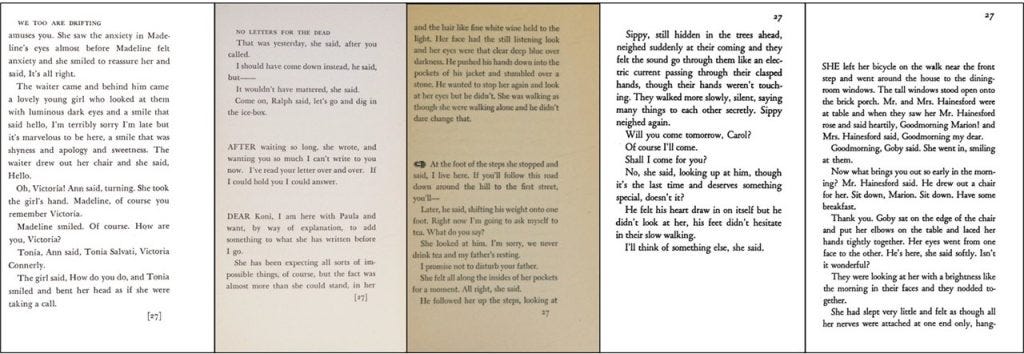
Wide margins and generous leading more common to books of poetry than novels.
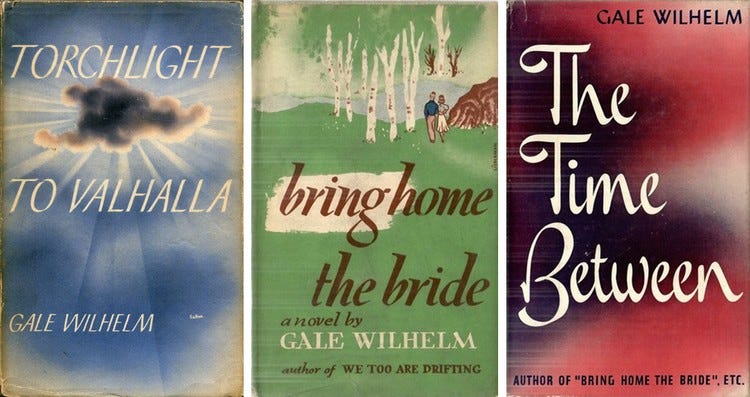
The dust jackets as well are subdued. Drifting and Letters (designed by Ernst Reichl) had acetate bands rather than conventional paper jackets, which is why few have survived. Torchlight merely shows a cloud, The Time Between just foggy blobs of red, purple, and white.
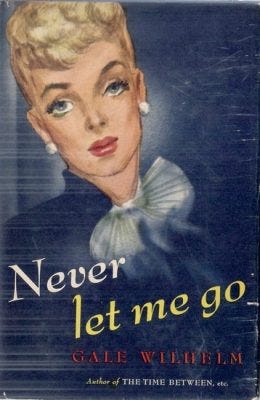
Without even reading Wilhelm’s last novel, Never Let Me Go (1945), however, it’s obvious that much has changed. The cover features a blonde woman with doe-like expression, pearl earrings, dark blue jacket and gauzy white bow. And when I say doe-like, I mean that the woman’s eyes are so widely spaced that they’re more like a deer’s than a human’s.
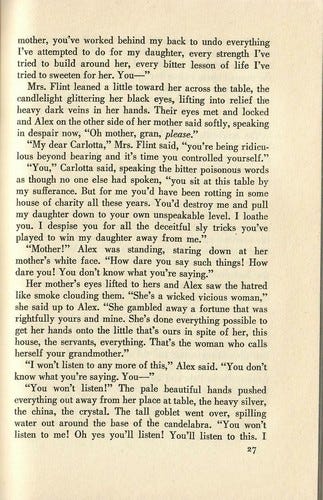
Flip to page 27, and now the paper is packed with words. Yes, this is partly due to wartime paper conservation requirements, but Never Let Me Go is, by word count alone, 50% longer than any of Wilhelm’s previous novels. There are quotations marks, even italicized words, and virtually all dialogue is clearly attributed to a speaker — all props to a reader that Wilhelm previously shunned.
While Harry Hansen might complain that the characters in Never Let Me Go still aren’t flesh and blood, he would at least be able to identify their height, weight, hair and eye color, and distinctive facial marks to a detective, as well as what they were wearing. Likewise the cars they drive and the features of the rooms they occupy:
The room was done all in pale lemon yellow and there were two deep chairs with ottomans and a low table holding ashtrays and magazines and a telephone and a pair of yellow lilies floating motionless in a square blue bowl. Four framed watercolor landscapes hung in a row on the wall opposite the office door. Watching her closely he saw her eyes pause with them and he said, “Perhaps you know them. They’re Kojimas.”
Mason, the speaker, the tough-minded boss interviewing Alex, the beautiful and talented candidate, for the job of secretary, goes on to give a synopsis of Kojima’s life (mentioning that he’s now an inmate in a relocation camp).
In her previous novels, Wilhelm might have mentioned that there were four Kojimas on the wall of a room her characters were in, left us wondering if we should recognize the artist or if it were someone she just made up, and moved on because interior decoration just wasn’t relevant, wasn’t necessary.
When Never Let Me Go came out, Joseph Henry Jackson, then dean of California critics and a consistent supporter of Wilhelm’s work, used his regular “Bookman’s Notebook” feature to take issue with her choices. Unlike her first five books, which could seem challenging to those unfamiliar with modernist prose, Never Let Me Go “wouldn’t disturb the most exigent reader of magazine fiction.” Even though only two of the five had dealt with queer relationships, there had been a consistent aesthetic across all — lean prose, spare plotting, almost miserly use of details.
Now, however, Jackson wrote, “The trappings of the tale — streamlined office, handsome boss, high-powered business trips, and all the rest of it — are straight-out slick-paper, and no two ways about it.” After presenting his evidence, he leveled his charge straight at the author: “This isn’t, in my view, Gale Wilhelm ‘as is.’ It’s Gale Wilhelm writing a novel of a kind that isn’t really her own, in a manner that isn’t natural to her.”
Other reviewers were pleased to see Wilhelm conforming to conventions, but none found anything to distinguish Never Let Me Go from the other middlebrow women’s novels covered in every week’s book section. And by the time that Wilhelm’s work was being recognized for its place in literary history, the accepted narrative was that she abandoned queer relations and characters and compromised her artistic integrity in pursuit of more commercially viable heterosexual subjects.
In her article on Wilhelm in The Gay and Lesbian Literary Heritage, Harriette Andreadis credits her for presenting, in Drifting and Torchlight, “lesbian relations unapologetically. In these works, she makes no effort to explain or justify or plead a cause…but presents her characters enmeshed in very human, often confused relations, attached to each other through not always the most admirable of emotions or motivations.” But Andreadis also records that Wilhelm’s last three novels were “described as mannered and precious” and Never Let Me Go in particular as “shallow.”
Elizabeth Blake appears to be the only scholar to have taken a serious look at Wilhelm’s last three novels. In her 2024 article, “Queering the Marriage Plot: Gale Wilhelm’s Middlebrow Modernism,” Blake acknowledges the extent to which Wilhelm’s work as a whole has been largely forgotten at the start: “Most readers of this essay will likely not have heard of Gale Wilhelm.” Through close analysis of the plots and characters’ free indirect discourse, she argues that Wilhelm did not abandon queer subjects but rather transformed conventional heterosexual romance and marriage narratives through a queer sensibility: “Put another way, Wilhelm’s late (or “straight”) novels resist the congealing of any particular relationship between sexuality and normativity, imagining instead the possibility that queerness might be made palpable within the orthodox structures of heterosexuality.”
Blake sees Wilhelm’s each last three novels as, effectively, “a critique of heteronormativity.” This interpretation creates “a more cohesive narrative of her career, one in which the sophistication of her work is not derived solely from its modernist aesthetics, but is legible instead in the way she uses modernist aesthetics to reimagine what middlebrow plots can do.”
It’s not implausible. The romance between Mason and Alex, already at a steady simmer by the middle of Never Let Me Go, is vehemently opposed by Mason’s sister, Ann, because, she suggests, Alex is not a “real woman”:
“I saw through you the minute I laid eyes on you, years ago and then again the other night. You’re not a woman at all! You’re trying to play a woman’s game and Mason’s blind as a bat or he’d see it — the idiot, talking about your beautifully tailored clothes!” She laughed into Alex’s still face. “They’re certainly tailored all right! And so are you, right down to your heels. Well, you might have the decency to play in your own field and leave decent people like Mason to their own sort!”
But despite these references — “play your own field,” “leave decent people…to their own sort” — unsubtle enough that even “slick-paper” readers would get them, and other examples of gender boundary-testing behavior (e.g., Mason tries on a pair of earrings before presenting them to Alex), Never Let Me Go ends precisely on formula. Now Mr. and Mrs. McGowan, they walk off together, “their arms linked, her arm held close against his side.”
I differ with Blake’s interpretation when it comes to Never Let Me Go. Even with their heterosexual narratives, No Letters for the Dead, Bring Home the Bride, and The Time Between are overwhelmingly coherent with We Too Are Drifting and Torchlight to Valhalla. Anyone who’s read one will, within the first page or two, recognize another as a Gale Wilhelm novel.
Whether queer or hetero, Wilhelm creates relationships that remind me of the one Kurt Vonnegut’s Lord Haw-Haw-like character, Howard W. Campbell, tries to create with his wife in Mother Night: “A pair of lovers in a world gone mad could survive by being loyal only to a nation composed of themselves — a nation of two.” Alex and Mason, on the other hand, are stock characters going through a familiar marriage plot. The authorship of Never Let Me Go could be attributed to any of dozens of other writers. Hell, it’s not that far afield from one of Faith Baldwin’s working women romances (The Office Wife, Wife vs. Secretary, Self-Made Woman, etc., etc.).
Compare also the realities of the publishing world in the late 1940s with those facing Gale Wilhelm at the start of her career. She, like Jan Morale in Drifting, was part of the radical movements that sprang up in response to the Depression, movements that were more open to sexual, racial, and cultural minorities. After successful censorship battles over the publication of The Well of Loneliness, Bennett Cerf felt more comfortable about getting behind a book like Drifting, even if not so comfortable as to make it a regular feature in his catalogs.
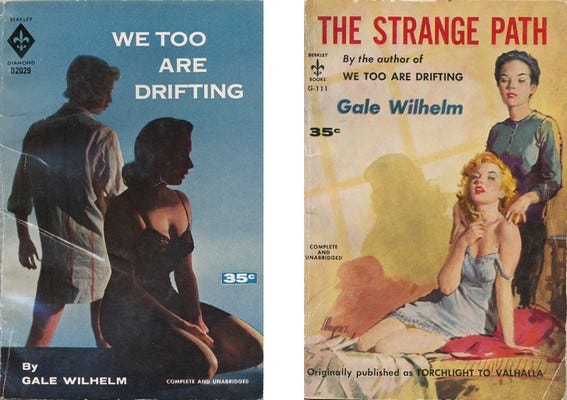
After World War Two, however, both radical politics and queer identity became high-risk ventures. Novels with queer themes were no longer safe for major publishers unless the subject was heavily camouflaged. The books disappeared from bookstore display tables and reappeared as pulp paperbacks with lurid covers in drugstore carousel racks. Berkley reissued Drifting and Torchlight (renamed The Strange Path) in 1953, but Wilhelm would have been forced to write to this new formula (i.e., play up the titillation) had she wanted to continue writing about “abnormal” relationships. Had she been identified as a writer of such books, it would also have imperiled her partner, Kathleen Huebner, who worked as a secretary for a high-profile Bay Area real estate developer, Robert Fraser. And if she had wanted to publish with the likes of Random House or Morrow, she would have had to churn out more slick-paper material like Never Let Me Go.
So, as far as we know, she stopped. Perhaps she didn’t stop writing: in 1950, she still identified herself as a writer to the census taker. Perhaps she published — writing to either the pulp or the mainstream middlebrow formula — under a pseudonym, though the pseudonymous work of large number of authors has subsequently been traced to their creators, so this seems unlikely. But she certainly stopped publishing as Gale Wilhelm books that are unmistakably Gale Wilhelm’s. If so, it must have been an intensely difficult decision. It may have been the surrender of her voice in the interest of protecting her own nation of two. Whatever the case, that surrender was our loss as well.
Fascinating article. Never heard of her which is I guess your point in publishing this piece but found it incredibly interesting!